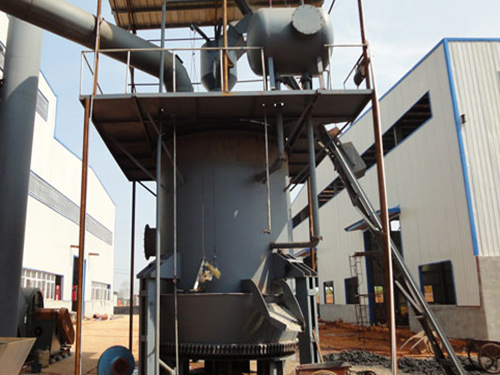
1. Blocking flow
(1) The anti-flow circle is an anti-flow measure, which uses the deflection method to change the descending route of the material, so that its moving route is changed to slow down the flow. At that time, the slag-breaking bar was still a unified original design. The anti-flow ring was a steel plate ring positioned at the lower end of the slag-breaking bar and extending around 12 mm inward. The purpose was to prevent ash and slag from sliding down the inner wall of the jacket, and to a certain extent prevent wall flow. Under the condition that the diameter of the grate was relatively small at that time, it played a certain role in stabilizing the furnace conditions.
(2) The ash retaining plate is located above the slag outlet in the furnace and extends the upper shell of the ash silo into the furnace. Its length is 1200mm, but its width varies. The inwardly extending ash retaining board occupies a certain width of the ash channel area and plays a role in controlling the fall of ash. This method and the flow prevention ring are traditional flow prevention measures. The anti-flow principle of the ash barrier belongs to the deflection method, which is used to change the movement route of the material and prevent the ash from directly collapsing into the ash discharge port and causing the coal to flow into the ash box.
2. Blocking and throttling
This method is to reduce the ash discharge area of the ash discharge port, control the ash discharge speed, and at the same time reduce the repose angle of the ash discharge port by lowering the height of the ash discharge port. But the negative impacts are also obvious and even extremely harmful. The downward extension of the slag breaking strip can only be used as an incidental measure in conjunction with other flow prevention methods, and cannot be regarded as the main measure. Lowering the height of the ash discharge port must not be lowered too much.
Because the ash discharge port is an ash metabolism channel, reducing the height of the ash discharge port is equivalent to reducing the area of the ash discharge channel, which directly reduces the ash discharge capacity. This method can also be used under the condition that the raw coal used is of good quality and the production load of the gas generator is light. However, this method cannot be simply used when the quality of the raw coal is poor, when briquettes are used as raw materials, or when the gas generator has a heavy production load.
3. Delayed flow
The addition of an inactive outer ash pan is to imitate the flow prevention measures of the ∮2745~∮3300 gas generators. However, the outer ash pans of the ∮2745~∮3300 gas generators are in the original design and were cast at the same time when the chassis was manufactured.
∮In order to prevent flow of the 2-meter series gas generator, a steel special-shaped plate is added to the outer edge of the ash pan within the range of the ash discharge port, and is expanded parallel to a certain width, with varying widths. The principle of this method is different from the above two methods. It is to increase the flow distance of ash and slag and increase the resistance generated by itself in the flow area when the ash is discharged. This method is the flow blocking method. The application time of the flow blocking method on the ∮2-meter series gas generator is relatively short compared to other methods, but compared with the other two methods, it is a reasonable flow prevention measure.