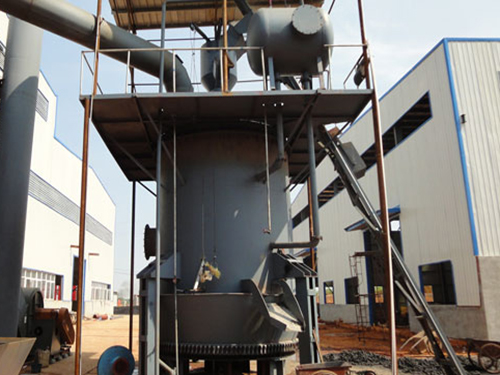
Working principle of gas generator:
Producer gas is generated by mixing water vapor and air to form a gasification agent and then flowing through a hot fixed combustion bed. The oxygen and water vapor contained in the air react with the carbon in the fuel to generate producer gas containing CO, CO2, H2, CH4, N2 and other components. Vapor mixed with air increases thermal efficiency and reduces combustion bed temperature, thereby controlling frit formation. The reaction between steam and carbon is an endothermic reaction: C+H2O=CO+H2-Q (Q is heat, the same below) When oxygen and carbon react, heat is released: 2C+O2=2CO+Q. The temperature of the combustion bed depends on the saturation temperature of the gasification agent, the particle size and type of the fuel and the furnace type of the generator. The temperature of the combustion bed is important because for a given fuel and furnace type, it determines the composition of the furnace gas: at high temperatures, a large amount of combustible gas can be produced. Therefore, it is important to keep the combustion bed high without forming clinkers. The temperature at which the frit is formed depends on the slag melting characteristics of the fuel. When there is sufficient oxygen, two reactions will occur: 2CO+O2=2CO2+QC+O2=CO2+Q. Therefore, the production of CO does not necessarily mean that any carbon combustion can reduce the calorific value of gas. In addition, some water vapor also reacts with CO, because when each volume of CO is converted into CO2, the same volume of H2 is also generated: CO+H2O=CO2+H2. Therefore, there is no heat loss. In the reduction layer, when its temperature is lower than 1200°C, the following rapid reaction will occur: CO2+C=2COH2O+C=CO+H2. When the coal gas passes through the reduction zone, the combustible gas content rises rapidly, while the CO2 and water vapor content decreases. After passing through the reduction zone, some gas is extracted and flows through the bottom cyclone dust collector and forced air cooler. This gas is called“bottom gas”, its temperature is about 400℃. In the retort layer, the fuel fed to the generator is dried, preheated and carbonized in sequence. The generated steam, tar mist and gas leave the generator together from the top. This part of the gas is called“top gas”, its temperature remains around 120°C.
Gas generator technical parameters:
|
name |
unit |
Producer specifications |
- |
- |
- |
- |
- |
- |
- |
|
Furnace diameter |
mm |
1600 |
1800 |
2000 |
2400 |
2600 |
3000 |
3200 |
3400 |
|
Furnace cross-sectional area |
m2 |
2 |
2.54 |
3.14 |
4.52 |
5.31 |
7.07 |
8.04 |
9.08 |
|
fuel layer height |
mm |
1000 |
1000 |
1000 |
1000 |
1000 |
1000 |
1000 |
1000 |
|
Fire level height |
mm |
100~300 |
- |
- |
- |
- |
- |
- |
- |
|
Gray layer height |
mm |
100~300 |
- |
- |
- |
- |
- |
- |
- |
|
Applicable fuel |
Non-caking bituminous coal, anthracite, coke |
- |
- |
- |
- |
- |
- |
- |
- |
|
fuel particle size |
mm |
13~25 25~50 |
- |
- |
- |
- |
- |
- |
-- |
|
fuel consumption |
Kg/h |
350~460 |
500~600 |
500~720 |
700~1040 |
850~1200 |
1700~2000 |
1800~2200 |
2500~2800 |
|
gasification agent |
air, water vapor |
- |
- |
- |
- |
- |
- |
- |
- |
|
Gas production |
Nm3/h |
1200~1600 |
1500~2100 |
1750~2500 |
2500~3600 |
3000~4300 |
6000~7000 |
6500~7500 |
7000-9000 |
|
Ash disk speed |
r/h |
3.5 |
3.5 |
2.23 |
2 |
1.7 |
1.7 |
1.7 |
1.5 |
|
Gas calorific value |
KJ/Nm3 |
5020~5670 |
- |
- |
- |
- |
- |
- |
- |
|
Gas outlet temperature |
℃ |
400~550 |
- |
- |
- |
- |
- |
- |
- |
|
gas outlet pressure |
Pa |
980~1470 |
1470-1960 |
- |
- |
- |
- |
- |
- |
|
blast pressure |
Pa |
<4000 |
<6000 |
- |
- |
- |
- |
- |
- |
|
saturated air temperature |
℃ |
50-65 |
- |
- |
- |
- |
- |
- |
- |
|
Water jacket working pressure |
Pa |
<100Kpa |
<294Kpa |
- |
- |
- |
- |
- |
- |
|
Fire hole pressure |
Pa |
<100Kpa |
<294Kpa |
- |
- |
- |
- |
- |
- |
grate drive
Motor power |
KW |
4 |
5.5 |
- |
- |
- |
- |
- |
- |
Coal bucket lifting
Motor power |
KW |
1.5 |
3 |
- |
- |
- |
- |
- |
- |
|
Total equipment weight |
T |
12 |
15 |
19 |
24 |
28 |
42 |
45 |
55 |