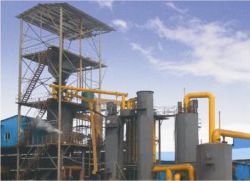
Two-stage gas generatorsewage discharge and treatment
1. Generation and treatment of water pollutants: The main wastewater from gas generators is gas condensate and circulating water for indirect cooling of gas. The two-stage gas generator uses indirect cooling water for purification. The water and gas are not in direct contact, only the temperature is increased, and it can be recycled. The production of gas condensate depends on the quality of gasified coal and the gasification process used. Generally, the condensate produced by gasifying bituminous coal in a two-stage gas generator is about 100kg/t coal. The condensate is phenol-containing wastewater and mainly contains phenols, cyanide, tar, suspended solids, sulfide and ammonia nitrogen. Among them, monovalent phenols are the main phenols, with phenol having the highest content, followed by m-cresol, with a phenol content of about 8500 to 10000 mg/L. Phenol cyanide wastewater is toxic and can cause poisoning of personnel.
2. Generation and treatment of air pollutants: The gas generator will emit a small amount of gas-containing waste gas during ignition operation and when emergency gas supply is stopped. The gas discharge pipe can be opened and a torch is installed on the discharge pipe. The discharged waste gas can be ignited and burned. A small amount of dust is generated when loading coal into the coal bunker. The emission volume is 5000m3/h and the dust concentration is 1000mg/m3. A bag dust collector is required. The dust removal efficiency can reach more than 99%. The dust emission concentration can meet the secondary standard of the "Comprehensive Emission Standard of Air Pollutants" (GB16297-1996).
3. Noise generation and control: mainly fans and water pumps. The fan source strength is 80-90dB (A) and the water pump source strength is 75-85dB (A). The fan vibration isolator should choose a large damping spring isolator to ensure the stiffness and damping ratio of the vibration isolator; install a muffler at the air inlet and outlet to reduce the sound of the air entering the air outlet; install sound-absorbing materials in the fan room, and set up sound-insulating doors and windows. Use advanced equipment to improve the installation accuracy of the water pump, do balance debugging, and adopt shock absorption and vibration isolation measures for installation. Install vibration isolation components (such as shock absorbers, rubber isolation pads, etc.) between the water pump and the foundation. Increase the weight of the inert block (reinforced concrete foundation) to increase its stability, thereby effectively reducing vibration. At the same time, install mufflers, and lay glass wool and other sound-absorbing materials on the walls around the equipment room.
4. Solid waste generation and treatment: mainly gasifier slag, gasifier dust ash and tar, etc. The annual production of gas generator slag and gas generator dust removal ash is about 1250t/a, which can be comprehensively utilized (paving roads or filling pits). The amount of tar produced is 200t/a, which is a hazardous waste (numbered HW11). Tar is a semi-solid hazardous waste and is stored in containers. Containers must meet the following requirements: Containers that meet standards should be used to contain hazardous waste. Containers and materials used to carry hazardous waste must meet corresponding strength requirements. Containers containing hazardous waste must be intact. The materials and linings of containers containing hazardous waste must be compatible with (non-reactive with) the hazardous waste. Sufficient space must be left in the container, with a space of more than 100mm between the top of the container and the liquid surface. Containers containing hazardous waste must be affixed with labels shown in Appendix A of the "Pollution Control Standards for Storage of Hazardous Wastes" (GB18597-2001), and should ultimately be handed over to a unit with hazardous waste disposal qualifications for disposal.