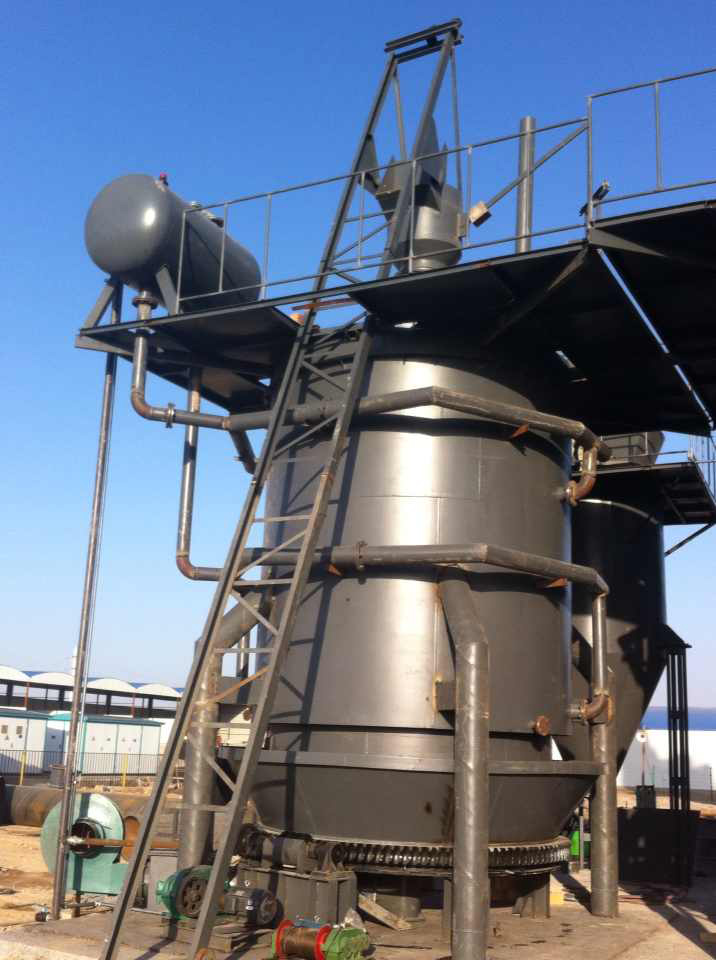
in general
gas generatorIn the process, the coal moves from top to bottom and the gasifying agent moves counter-currently from bottom to top. Chemical reactions and heat exchanges occur between them. In this way, several areas are formed in the gas generator, which are generally called“layer”. According to the gasification process in the gas generator, the interior of the gas generator can be divided into six layers: ash layer; oxide layer (also called fire layer); reduction layer; carbonization layer; drying layer; and empty layer. The oxidation layer and reduction layer are collectively called the reaction layer, and the carbonization layer and drying layer are also collectively called the coal preparation layer.
(1) Ash and slag layer: After coal is burned, ash is produced to form an ash and slag layer, which is at the bottom of the furnace and covers the grate. Its main functions are: to protect the grate and wind cap from being burned by the high temperature of the oxide layer; to preheat the gasification agent. After the gasification agent enters from the bottom of the furnace, it first undergoes heat exchange through the ash and slag layer to reduce the temperature of the ash and slag layer and increase the temperature of the gasification agent. Generally, the gasification agent can be preheated to about 300-450℃. The ash layer also plays a role in air distribution, so that the incoming gasifying agent is distributed as evenly as possible in the furnace.
(2) Oxide layer: also called combustion layer (fire layer). The oxygen in the gasifying agent rising from the ash burns violently with carbon to generate carbon dioxide and releases a large amount of heat. It is one of the main areas in the gasification process, and its main reaction is: C+O2→The height of the CO2+97650 kcal oxide layer is generally 3-4 times the size of all fuel blocks, generally 100-200 mm. The temperature of the gasification layer is generally lower than the ash melting point of coal and is controlled at around 1200°C.
(3) Reduction layer: Above the oxide layer is the reduction layer. Red-hot carbon has a strong ability to steal oxygen from oxides and combine with it, so in the reduction layer, carbon dioxide and water vapor are reduced to carbon monoxide and hydrogen by carbon. This layer is also called the reduction layer. Since the reduction layer is located above the oxide layer and obtains a large amount of heat from the rising gas, the reduction layer has a higher temperature of about 800-1100°C, which provides conditions for the reduction reaction that requires heat absorption. Strictly speaking, the reduction layer is divided into the first and second reduction layers. The higher temperature in the lower part is called the first reduction layer, with a temperature of 950-1100°C, and a thickness of about 300-400 mm; the second layer is between 700-950°C, and its thickness is 1.5 times that of the first reduction layer, about 450 mm.
(4) Retort layer: The retort layer is located at the upper part of the reduction layer. The temperature of the gas rising from the reduction layer gradually decreases as the heat is consumed. Therefore, the temperature of the retort layer is about 150-700°C. At this temperature, the coal undergoes the process of low-temperature retort and the volatile components in the coal crack to produce methane, olefins, tar and other substances. They become vapor when heated, that is, coal gas is generated and escapes through the upper drying layer to become a component of the coal gas. The height of the retort layer varies with the volatile content of the fuel and the operating conditions of the gas furnace, and is generally >100 mm.
(5) Drying layer: The drying layer is located above the carbonization layer, which is the surface layer of the fuel. The rising hot gas and the fuel that has just entered the furnace meet at this layer, and heat exchange occurs, and the water in the fuel is heated and evaporated. It is generally believed that the drying temperature is between room temperature and 150°C. The height of this layer also varies with various operating conditions, and there is no relatively stable layer height.
(6) Empty layer: The empty layer is the upper part of the fuel layer and the free area in the furnace body. Its main function is to collect gas.