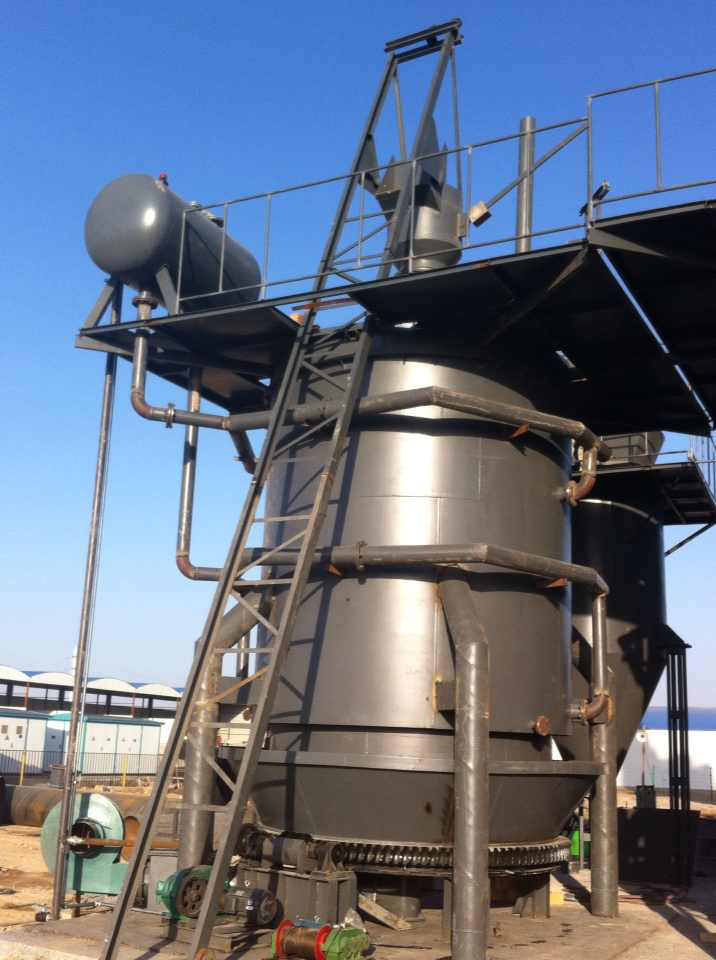
Stoker
The stoker uses double bell type, mechanical or barrel type (hydraulic) stoking. This structure can effectively prevent gas leakage. When adding coal, the double cover is closed, the winch mechanism pulls the trolley to add coal to the upper chamber of the stoker, and then the trolley falls back by its own weight. At the same time, the lower bell is closed, the upper bell is opened, and the coal falls into the lower chamber of the stoker. Then the upper bell is closed, the lower bell is opened, and all the coal falls into the furnace. Finally, the lower bell is closed to complete one coal addition.
Furnace body
The main body of the furnace is composed of furnace cover, water jacket, grate, chassis device, air inlet box and other components.
The furnace cover is welded from steel plates and lined with refractory and insulating castables. The material of the inner ring plate is 20g, and the material of the outer ring plate is Q235-B. They are welded and manufactured in accordance with the relevant specifications for pressure vessels, which can ensure the safety of the gas station. The water jacket is connected to the steam collecting drum, forming a natural circulation system of softened water from top to bottom. The softened water first enters the steam collecting drum, and then descends from the steam collecting drum into the water jacket. After being heated, a steam-water mixture is produced, which travels from the riser to the steam collecting drum. The steam is separated by the steam-water separation device and used as a gasification agent. For the water in the water jacket, the use of tap water for a short period of time can only be allowed when the supply of softened water is stopped to temporarily maintain production.
The undercarriage consists of a worm gear or ratchet and an ash pan. The worm gear or ratchet and the grate are fixed on the ash tray. The grate equipped by our company is designed after many years of research and design, which can ensure uniform air distribution at the bottom of the furnace. The ash removal on both sides can effectively prevent the gas furnace from being deflected during operation and reduce the blast resistance, thus reducing the carry-over, which is conducive to the purification of the gas. A rolling bearing is installed under the ash pan. When the ash pan rotates, the grate rotates at the same time. The ash falls into the ash pan. The small ash knife crushes the ash and the large ash knife discharges the ash pan. The middle air inlet box and the lower water sealing ring of the ash pan form a water seal.
Dust cleaning device
Double ash knives are used for ash cleaning. The ash is cleaned on both sides and the ash is discharged evenly. This can effectively prevent partial furnace operation due to uneven ash discharge. The ash knives provided are punched and rolled with bidirectional spiral molds, which can effectively reduce the resistance to ash discharge. The large ash knife adopts a self-designed plow-type ash remover, which has stable and reliable transmission and smooth ash removal. Our company's plow-type ash remover has been used in many domestic and imported furnaces and is well received by users. The dust cleaner is hydraulically driven on both sides, with a ratchet and pawl structure. The hydraulic station controls the swing hydraulic cylinder to reciprocate, so that the pawl drives the ratchet wheel to complete the step of the ash tray to achieve the purpose of cleaning. Compared with the worm gear structure, the cleaning driving force of this structure all acts on the tangential direction of the ratchet, without excess power loss, high mechanical efficiency, and no radial runout, extending the service life of the ratchet.