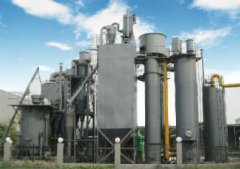
Air as the gasification agent is blown from the air nozzle on the side wall of the gasifier, and the flow direction of the produced gas is consistent with the direction of material falling, so the downdraft gasifier is also called a downstream gasifier. The blown air and materials are mixed and burned. This area is called the oxidation zone, with a temperature of about 900-1200°C. The heat generated is used to support the cracking reaction in the pyrolysis zone and the reduction reaction in the reduction zone. The upper part of the oxidation zone is the pyrolysis zone, with a temperature of about 300-700°C. In this area, the volatile matter (pyrolysis gas, tar and moisture) in the biomass Separate; the upper part of the pyrolysis zone is the drying zone, where the materials are preheated; the lower part of the oxidation zone is the reduction zone, where the CO2, carbon, and water vapor generated in the oxidation zone undergo a reduction reaction. At the same time, the residual tar undergoes a cracking reaction in this zone, producing gases dominated by CO and H2. The temperature in this zone is about 700 to 900°C. Since the tar-rich gas from the pyrolysis zone must pass through a high-temperature oxidation zone and a reduction zone dominated by hot coke, the tar in the gas is cracked at high temperature, thereby greatly reducing the tar in the produced gas.
Characteristics of downdraft biomass gasifier
a. In order to make the temperature of each part of the oxidation zone uniform and prevent dead zones and overheated zones, so as to ensure that the tar cracking reaction proceeds to the maximum extent, the cross-sectional size of the lower part of the hopper of the downdraft gasifier becomes smaller. This part is the so-called“larynx”,“larynx”The size determines the gas production capacity and gas quality of the gasifier.
b. In order to ensure full mixing of materials and air,“larynx”Arrange multiple air nozzles. Generally, there are two arrangements: external spray (air is sprayed from the outside of the throat to the center) and internal spray (air is sprayed outward from the air supply pipe in the center of the throat). The first form is more commonly used.
c. On the outer wall of the hopper, most downdraft gasifiers are welded with fins to increase the heat exchange area. The purpose is to use the heat of the produced gas to preheat the materials in the hopper, while also reducing the temperature of the produced gas and improving the thermal efficiency of the gasifier.
d. Since the reduction zone is located in the lower part of the oxidation zone and the cracking reaction in the high-temperature zone exists, a flame temperature stabilizing effect is produced in the downdraft gasifier. That is, when the reaction temperature is high, the endothermic reduction reaction is relatively intensified, thereby reducing the gas temperature; when the reaction temperature is low, the reduction reaction is relatively slowed down, and the exothermic oxidation reaction is dominant, which in turn increases the gas temperature. The flame temperature is stable at 800 to 1200°C, so that the composition of the produced gas is relatively stable.
e. Due to the small cross-sectional area“larynx”The existence of downdraft gasifiers has certain limitations in terms of load adaptability. Under the same appearance and size conditions, its gas production capacity is lower than other structural types of gasifiers, especially updraft gasifiers.